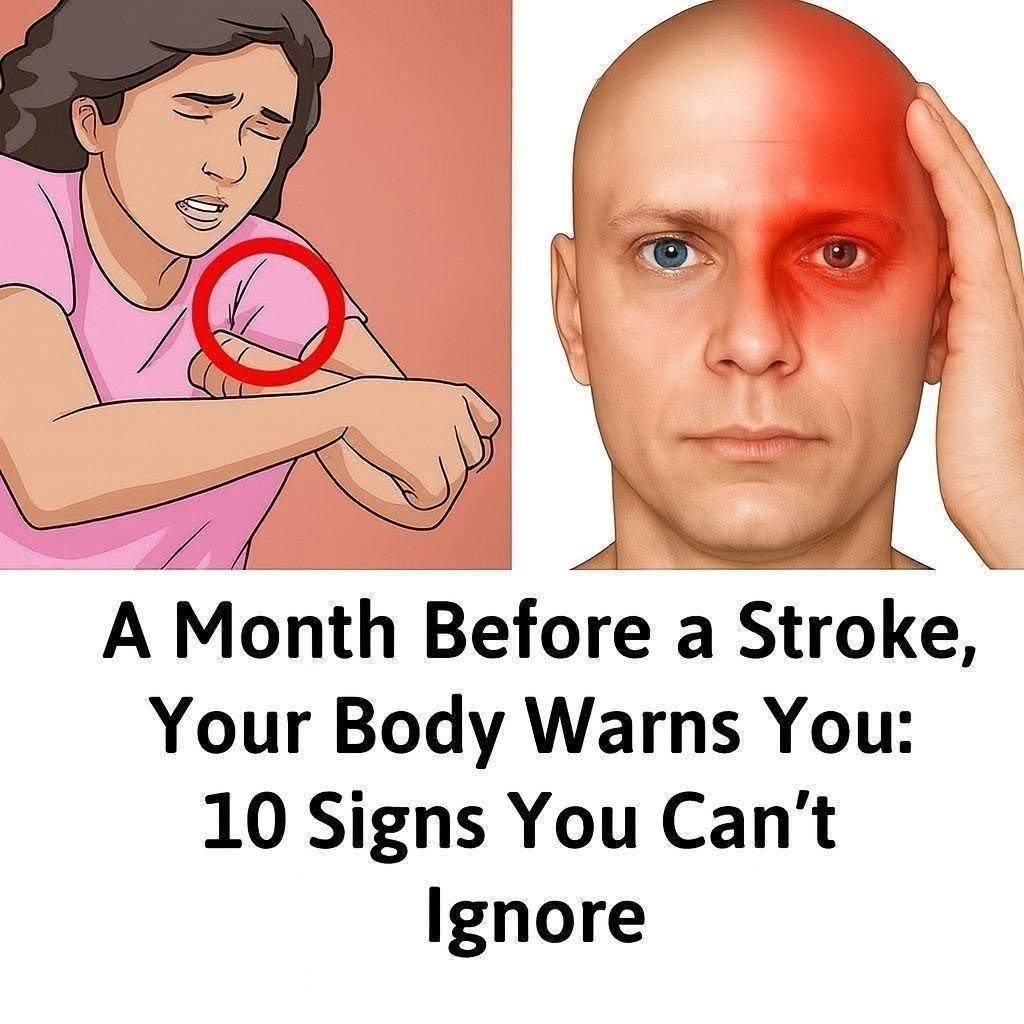
A Month Before a Stroke, Your Body Warns You: 10 Signs You Should Know
The idea that the body gives everyone a predictable set of warnings exactly one month before a stroke is misleading.
A stroke can happen suddenly, and many people have no reliable warning symptoms beforehand. However, some people experience a transient ischemic attack (TIA), sometimes called a “mini-stroke,” before a major stroke.
A TIA occurs when blood flow to part of the brain is temporarily disrupted. Its symptoms can disappear quickly, but that does not make it harmless. A TIA is an important warning that requires urgent medical evaluation.
Here are ten symptoms that should never be casually dismissed.
1. Sudden Weakness on One Side
Sudden weakness or loss of strength in the face, arm, or leg—particularly on one side of the body—is a classic stroke warning sign.
Someone may suddenly have difficulty lifting one arm, walking normally, or controlling one side of their body.
Even if the weakness disappears, urgent medical assessment is important.
2. Sudden Numbness or Loss of Sensation
A sudden feeling of numbness, tingling, or reduced sensation in the face, arm, or leg can occur during a stroke or TIA.
One-sided symptoms are particularly concerning.
Do not assume that temporary symptoms are harmless simply because they go away.
3. Sudden Trouble Speaking
A person may suddenly have difficulty finding words, speaking clearly, or producing understandable speech.
They may also suddenly struggle to understand what another person is saying.
This can be a sign of disrupted blood flow to areas of the brain involved in language.
4. Sudden Facial Drooping
One side of the face may suddenly appear weaker or droop when the person smiles.
A family member may notice this before the person experiencing it realizes anything has changed.
Facial drooping combined with weakness or speech problems is an emergency.
5. Sudden Vision Changes
Stroke and TIA can cause sudden vision problems, including loss of vision in one or both eyes or changes in part of the visual field.
Sudden double vision can also occur.
New, unexplained vision changes should receive prompt medical attention rather than being assumed to be ordinary aging or tired eyes.
6. Sudden Difficulty Walking
A sudden change in walking ability can be a neurological warning sign.
Someone may unexpectedly become unsteady, have trouble coordinating their movements, or feel as though they cannot control their walking normally.
Sudden loss of coordination is particularly concerning when it occurs with other neurological symptoms.
7. Sudden Severe Dizziness
Sudden dizziness or vertigo can have many causes, and most episodes are not strokes.
However, when severe dizziness begins suddenly—especially alongside difficulty walking, weakness, numbness, vision problems, or speech difficulties—it requires urgent assessment.
8. Sudden Loss of Coordination
A person may suddenly have trouble controlling their movements or performing a familiar physical task.
They might become unusually clumsy or have difficulty using an arm or leg.
A sudden neurological change should not simply be blamed on aging.
9. A Sudden, Unusual Severe Headache
Some strokes, particularly certain types of bleeding in the brain, can cause a sudden, severe headache.
A headache that is abrupt and unusually intense, especially when accompanied by neurological symptoms, requires emergency medical attention.
Not every severe headache is a stroke, but a sudden unusual headache should not be ignored.
10. A Brief Episode of Stroke-Like Symptoms
Perhaps the most important warning is an episode in which stroke-like symptoms appear and then disappear.
For example, a person might suddenly experience weakness, numbness, difficulty speaking, or vision loss that resolves after a short period.
That pattern can occur with a TIA.
Feeling normal again does not mean the danger has passed. Urgent evaluation is needed to determine the cause and reduce the risk of a future stroke.
Don’t Wait for a “Warning Month”
There is no dependable rule saying that these symptoms will appear one month before a stroke.
Some people experience a TIA before a stroke, while others do not have an identifiable warning event.
That is why waiting for a collection of symptoms to develop can be dangerous.
The most important response is to recognize sudden neurological changes and act immediately.
Remember FAST
A simple way to recognize common stroke symptoms is FAST:
F — Face: Is one side of the face drooping?
A — Arms: Is one arm suddenly weak or numb?
S — Speech: Is speech suddenly strange, unclear, or difficult?
T — Time: If these symptoms occur suddenly, seek emergency medical help immediately.
Other sudden symptoms—such as vision loss, severe dizziness, loss of coordination, or an unusual severe headache—can also require emergency attention.
What About Risk Factors?
Stroke risk is influenced by factors such as high blood pressure, diabetes, smoking, high cholesterol, certain heart conditions, age, and previous TIA or stroke.
Many risk factors can be managed with appropriate medical care and healthy habits.
Regular medical checkups can help identify problems such as high blood pressure or abnormal cholesterol before they cause complications.
Final Takeaway
A stroke does not reliably announce itself one month in advance.
The most important warning signs are sudden changes such as one-sided weakness or numbness, facial drooping, speech difficulty, vision problems, severe dizziness or loss of coordination, difficulty walking, and certain sudden severe headaches.
If stroke-like symptoms occur—even if they disappear—treat them as an emergency and seek medical care immediately. A temporary episode may be a TIA, and early evaluation can be critical.
