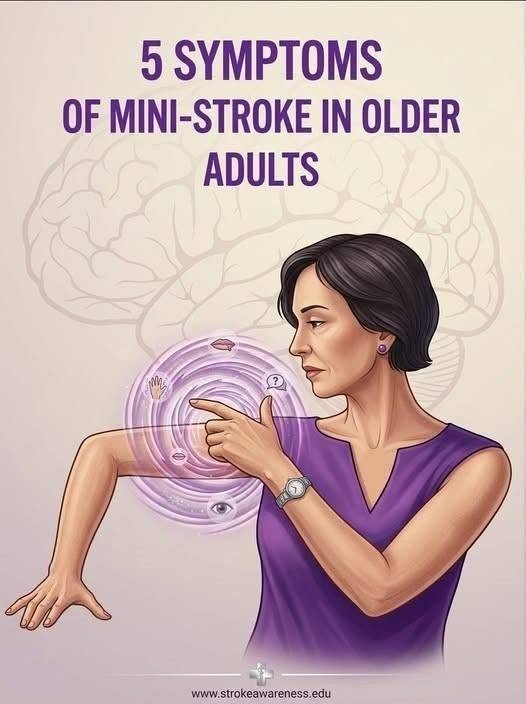
5 Symptoms of a Mini Stroke in Seniors That Shouldn’t Be Ignored
A transient ischemic attack (TIA), commonly called a “mini-stroke,” can be easy to dismiss because its symptoms may disappear after a short time.
That can be dangerous.
A TIA happens when blood flow to part of the brain is temporarily disrupted. Unlike many strokes, the symptoms may resolve without causing lasting brain injury that can be detected as an infarction. But a TIA can be an important warning that a person is at increased risk of a future stroke.
For older adults, recognizing the symptoms and seeking urgent medical attention is especially important.
1. Sudden Weakness or Numbness on One Side
One of the most recognizable warning signs is sudden weakness or numbness affecting the face, arm, or leg.
The person may suddenly have difficulty lifting one arm, gripping something, walking normally, or controlling one side of the body.
These symptoms can be frightening, but they may disappear quickly during a TIA.
Do not assume that everything is fine just because the weakness or numbness goes away.
2. Sudden Facial Drooping
A person may suddenly notice that one side of their face feels different or appears to droop.
Ask the person to smile. If one side of the face appears noticeably weaker or lower than the other, treat the change seriously.
Facial drooping becomes even more concerning when it occurs together with arm weakness or difficulty speaking.
3. Sudden Trouble Speaking or Understanding
A TIA can temporarily affect the brain regions responsible for language.
Someone may suddenly:
- Slur their words
- Have difficulty finding words
- Say things that don’t make sense
- Have trouble understanding what others are saying
Even if normal speech returns a few minutes later, urgent medical assessment is still necessary.
4. Sudden Vision Problems
Temporary vision changes can occur during a TIA.
Someone may suddenly lose vision in one eye, develop double vision, or experience a missing area in their field of vision.
Because vision changes can have many causes, they should not automatically be labeled a TIA—but sudden unexplained vision loss requires urgent medical evaluation.
5. Sudden Difficulty Walking or Loss of Balance
A TIA can sometimes cause sudden problems with coordination and balance.
An older adult may unexpectedly become very unsteady, have difficulty walking, or feel that their movements are no longer coordinated normally.
Sudden balance problems are particularly concerning when they occur alongside dizziness, weakness, numbness, vision changes, or speech difficulties.
Why a TIA Is an Emergency
A common misconception is that a TIA is harmless because the symptoms disappear.
It isn’t.
A TIA can serve as a warning that blood vessels supplying the brain have a problem that needs to be investigated.
Doctors may evaluate possible causes such as narrowed arteries, heart rhythm abnormalities, blood-clotting problems, or other cardiovascular risk factors.
Early evaluation can help identify and address factors that may increase future stroke risk.
Remember FAST
A useful way to recognize common stroke symptoms is FAST:
F — Face: Does one side of the face droop?
A — Arms: Is one arm suddenly weak or numb?
S — Speech: Is speech suddenly unclear, strange, or difficult?
T — Time: Seek emergency medical help immediately.
Other sudden symptoms—such as vision loss, severe dizziness, or difficulty walking—can also signal a stroke or TIA.
Don’t Wait for Symptoms to Return
If symptoms have disappeared, it can be tempting to wait and see whether they happen again.
That is not a safe approach.
A person who experiences sudden stroke-like symptoms should receive urgent medical assessment even if they feel completely normal afterward.
Do not drive yourself if emergency symptoms are occurring. Follow local emergency medical guidance.
What Can Increase Stroke Risk?
Stroke and TIA risk can be influenced by factors including:
- High blood pressure
- Diabetes
- High cholesterol
- Smoking
- Certain heart conditions
- Previous TIA or stroke
- Increasing age
- Some blood-vessel conditions
- Family history
Many risk factors can be addressed through appropriate medical care.
Taking prescribed medications as directed and attending recommended follow-up appointments are important parts of prevention.
Final Takeaway
Five important symptoms of a possible mini-stroke are sudden one-sided weakness or numbness, facial drooping, speech or language difficulties, sudden vision problems, and sudden difficulty walking or loss of balance.
The defining feature is often that the symptoms begin suddenly and may later disappear.
Never dismiss a possible TIA simply because the person feels better. A temporary episode can be an important warning, and urgent medical evaluation is the safest response.
