ATTENTION: These Are the Consequences of Ignoring Persistent Knee Pain
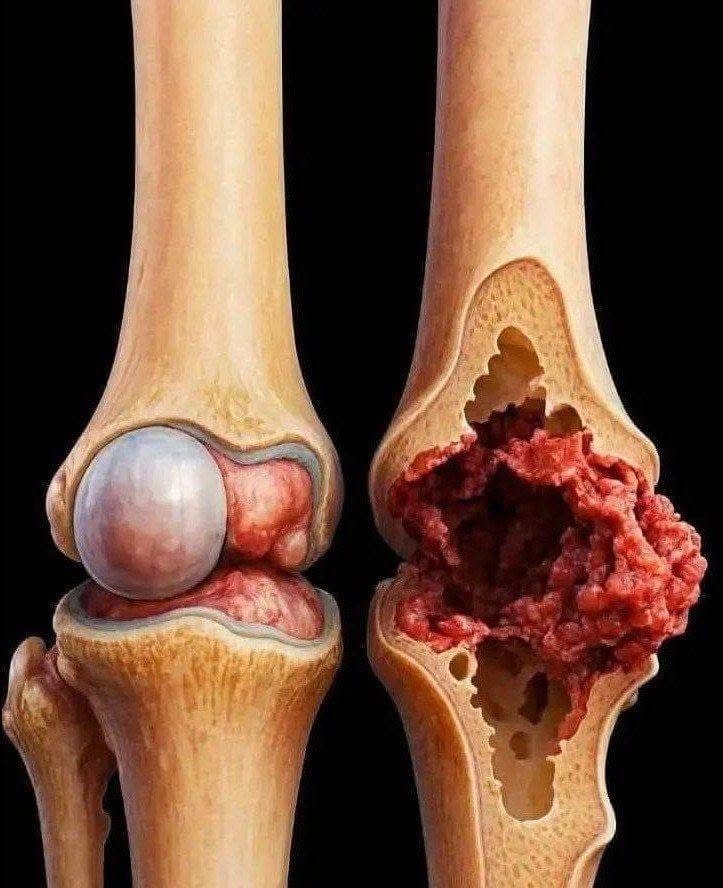
The image appears to be a medical-style illustration comparing a healthy knee joint with a severely damaged knee. The damaged side shows major changes to the joint and surrounding bone. While an illustration like this can look alarming, it is important to remember that knee pain does not automatically mean you have this type of severe damage.
1. What Can Damage the Knee?
Knee problems can develop for many reasons, including injuries, repeated stress on the joint, inflammation, or conditions such as osteoarthritis. Over time, damage to the structures that help the knee move smoothly can lead to pain and stiffness.
2. Common Warning Signs
Pay attention if you regularly experience:
- Knee pain during movement
- Stiffness after sitting or resting
- Swelling around the joint
- Difficulty bending or straightening the knee
- Pain when climbing stairs
- A feeling of weakness or instability
- Reduced ability to walk or perform normal activities
Occasional soreness after unusual activity is not necessarily a sign of serious disease, but persistent or worsening symptoms deserve attention.
3. Why Ignoring Pain Isn’t a Good Idea
Continuing activities that repeatedly aggravate an injured or painful knee may make symptoms harder to manage. Getting an appropriate evaluation can help identify whether the problem involves the joint, muscles, tendons, ligaments, or another structure.
4. Protect Your Knees
Healthy habits can support joint function. Regular age-appropriate physical activity, adequate rest after strenuous activity, good nutrition, and avoiding unnecessary joint strain can all be helpful.
If you have knee pain, choose activities that don’t significantly increase your symptoms rather than forcing yourself through pain.
5. When Should You Get Medical Advice?
Consider getting checked if knee pain persists, repeatedly returns, limits normal activities, or is accompanied by significant swelling, instability, or difficulty bearing weight.
Sudden severe pain after an injury, inability to use the leg normally, or major swelling should be assessed promptly.
Bottom Line
A dramatic image of a damaged knee can be useful for showing what serious joint disease may look like, but it cannot determine what is happening inside someone’s knee. Persistent pain, swelling, stiffness, or reduced movement is a reason to seek proper medical evaluation rather than assuming the worst.
